Do this right now. Open ChatGPT. Type in the question your ideal customer would ask to find a product like yours. Read the answer carefully. Is your brand in it?
If the answer is no or if you genuinely don't know you're not alone. Most marketing teams have no idea where they stand in AI search. They've spent years tracking Google rankings, but they've never once checked whether ChatGPT recommends them.
That gap is what this guide is about. We're going to walk through how to track your AI visibility from scratch no technical background needed, no expensive tools required to start. Just a process, a spreadsheet, and a bit of honest curiosity about where your brand actually stands.
First: what does "AI visibility" actually mean?
When someone asks an AI assistant like ChatGPT, Gemini, or Perplexity a question about your category "best CRM for startups," "top tools for social media scheduling," whatever your space is the AI generates an answer. That answer usually mentions a handful of brands.
AI visibility is simply how often your brand is one of them.
It's not about rankings in the traditional sense. There's no position 1 through 10. It's more binary than that: you're in the answer, or you're not. And if you're in it, the details matter are you mentioned first? Is the description positive? Is your website cited as a source?
In Google, there are 10 blue links. In AI search, there are 2 or 3 brand names. The stakes are higher and most brands aren't paying attention yet.
Tracking this isn't complicated. But it does require a system. Here's how to build one.
Step 1: Define your category queries
Before you can track anything, you need to know what to track. In GEO, the unit of tracking is a prompt a natural language question that your ideal customer might ask an AI engine.
These aren't keywords. They're full sentences. And the way they're phrased actually changes which brands get recommended.
Here are some examples for a B2B SaaS company:
"What's the best project management tool for remote teams?"
"Which CRM should a B2B startup use in 2025?"
"Top alternatives to HubSpot for small businesses"
"What analytics tools track AI search visibility?"
Start by making a list of 15 to 20 prompts. Think about it from your customer's perspective: what question would they ask an AI before they Googled, before they went to G2, before they asked a colleague?
Quick tip: Open ChatGPT or Perplexity and ask: "What questions would someone ask to find a [your product category]?" it'll give you a ready-made list you can copy and use immediately.
Aim for a mix of three types:
Category prompts : broad questions about your space ("best tools for X")
Use-case prompts : specific problems your product solves ("how do I track brand mentions in AI?")
Comparison prompts : questions that invite brand names ("alternatives to [competitor]")
Step 2: Run your first manual AI audit
This takes about 20 minutes and costs nothing. You're going to run your list of prompts across the major AI engines and record what you find.
The engines to check: ChatGPT (largest user base), Gemini (Google's AI), Perplexity (real-time web), and Claude (growing fast).
For each prompt, open each engine, paste in the question, and read the full response. Don't skim the details matter.
Important: Run each prompt in a fresh, private/incognito window with no prior conversation history. AI engines personalize responses over time you want the "cold" answer that a new visitor would see, not one shaped by your own browsing.
Step 3: Know exactly what to record
Reading the response isn't enough you need to log it consistently. Here are the four signals that actually matter.
Mentioned?
Is your brand in the answer at all? Yes or no. This is your baseline. If you're not mentioned across most prompts, that's the problem to fix first.
Position
If you are mentioned are you first, second, or fifth? AI engines tend to name the "default winner" first. Position 1 gets far more weight in the reader's mind than position 3. Track it.
Sentiment
How is your brand described? "Vizible AI is a popular tool for..." is very different from "Vizible AI is known for its enterprise-focused approach, which may not suit smaller teams." Read carefully. The framing shapes buying decisions.
Citations
In engines like Perplexity and ChatGPT with browsing, AI often cites web sources. Is your website or blog being cited? If a competitor's article is cited as the source for a description of your category, that's something to fix.
Put all of this into a simple spreadsheet one row per prompt per engine. After one pass, you already have your starting point. This is your baseline the thing everything else gets measured against.
Step 4: Track your competitors, not just yourself
The most important question isn't "am I mentioned?" it's "who is mentioned instead of me, and why?"
Go back through your spreadsheet. For every prompt where you're not mentioned, write down which brands are. After 15 prompts, patterns will emerge. You'll find one or two competitors showing up consistently. That's the brand owning your category in AI search right now.
Then do the detective work: read their content. See where they're being cited across the web. Check G2, Capterra, Reddit, and LinkedIn for how frequently they're discussed. That's what's driving their visibility and it tells you exactly what to build.
The share of voice metric: Count the total number of brand mentions across all your prompt results. What percentage is yours? That's your share of AI voice, the GEO equivalent of market share. Even a rough number gives you something to move.
Step 5: Make it a habit, not a one-time check
One audit tells you where you stand. A weekly or monthly cadence tells you whether you're moving and what's working.
AI visibility changes for a few reasons: the models update their training data, new content gets published (yours or your competitors'), and real-time retrieval engines pick up fresh articles immediately. If you publish a strong piece of content this week, Perplexity might start citing it within days.
A rhythm that works well for most teams:
Monthly full audit : run all your prompts across all engines, update the spreadsheet, note changes
Weekly spot-check : pick 3–5 key prompts and check Perplexity (most real-time) to catch fast-moving shifts
After publishing content : run the relevant prompts within a week to see if the new piece gets cited
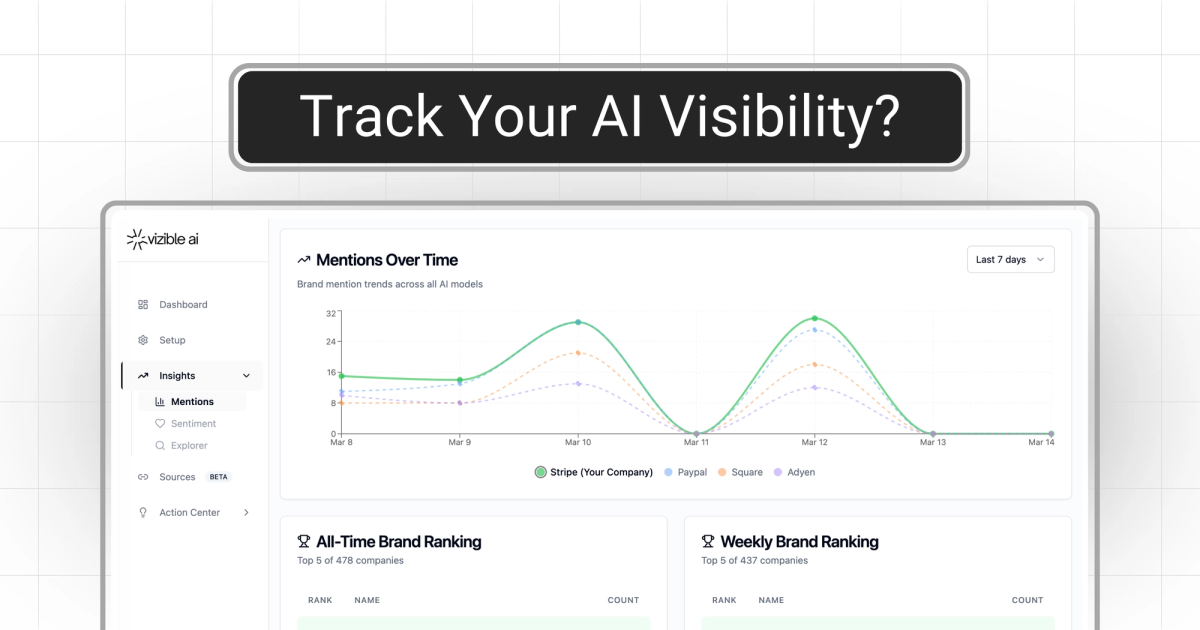
When manual tracking isn't enough: running 20 prompts across 4 engines manually every month is around 80 checks. It's manageable. But if you want to track 50+ prompts across all major LLMs daily including ChatGPT, Gemini, Claude, Perplexity, Mistral, and DeepSeek that's when a dedicated tool like Vizible AI starts making sense. It automates the entire run, extracts mentions and sentiment, and shows you the trends without the manual work.
Step 6: Turn your data into actual actions
Tracking without acting is just anxiety. Here's how to use what you find.
If you're not being mentioned at all
The model doesn't know enough about you or doesn't have enough confidence in what it knows. Your priority is entity recognition. Make sure your website clearly describes what you do in plain, factual language. Get listed on G2, Capterra, and Crunchbase. Get mentioned in at least a handful of independent sources outside your own site. Each consistent mention is a signal that compounds over time.
If you're mentioned but in low positions
You exist in the model's world, but you're not the default answer. The fix is usually content depth. Find the prompts where you're #3 or #4, and write the most comprehensive piece on the internet about that topic. Answer the question better than anyone else. Models surface brands that own topics and owning a topic means having the most thorough, most-cited content on it.
If sentiment is neutral or mixed
The model has seen your brand described in mediocre terms, probably from reviews or generic mentions. Go to where people talk about you: G2, Reddit, LinkedIn. Are the descriptions there what you'd want an AI to repeat? Engaging with those communities and making sure your positioning is consistent across third-party sources is the lever to pull here.
If your website isn't being cited
Your content isn't being found by real-time retrieval engines. Check that your robots.txt allows GPTBot and PerplexityBot to crawl your site. Then look at whether your content is genuinely better than what is being cited. Usually, the cited pieces are more thorough, more current, or more clearly organized than what you've published.
The honest truth about AI visibility
There's no shortcut here. AI visibility is built the same way real authority is built: by being genuinely present in your field, by producing content that actually helps people, by showing up consistently across the places where your audience talks.
The difference is the feedback loop. With Google, you'd wait weeks to see ranking movement. In AI search, Perplexity can pick up a new article within days. Real-time retrieval means your efforts actually show up faster than SEO ever did.
But the brands that win long-term in AI search won't be the ones gaming it. They'll be the ones that built genuine authority in their content, in their community, in the way they're consistently described across the internet. That's what the models learn from. That's what they repeat.
Start with the 20-minute audit. Build the spreadsheet. Make it monthly. The data will show you exactly where to put your energy.