



Ask yourself this honestly: do you know if ChatGPT is recommending your brand right now? Does Gemini cite you when someone searches for a tool in your category? Does Perplexity point to your site?
If you don't know, you're not alone. Most marketing teams are still only tracking their Google rankings. Yet in 2026, a growing share of brand discovery is happening directly through AI assistants. According to Gartner, traditional search volume is projected to drop by 25% by end of 2026 due to mass LLM adoption.
The result: ranking on Google is no longer enough. You also need to exist in AI answers. And for that, you need the right tools.
In this article we've reviewed the main tools on the market for tracking your LLM visibility, their strengths, their limits, and who each one is actually suited for.
Why tracking your AI visibility has become essential
When a user types "best CRM for startups" into ChatGPT, they get a direct answer with 2 or 3 brand names. Not a list of 10 links. Not a page 2. One answer, and that's it.
If your brand isn't in that answer, you don't exist for that user. And unlike Google where you can audit your position in a few clicks, LLM visibility is completely invisible unless you have the right tools.
AI visibility is measured through three distinct signals:
Mention: your brand name appears in the generated response
Citation: your content is used as a source (with or without a link)
Recommendation: you appear in a list like "best tools" or "alternatives to"
Each of these signals has a different impact on perception and conversion. A serious tracking tool needs to measure all three.
Running marketing in 2026 without AI visibility data is like driving with half your dashboard switched off.
What to look for in an AI visibility tool
Before comparing tools, here are the 5 criteria that actually make the difference:
1. Number of LLMs covered
ChatGPT dominates, but Gemini, Perplexity, Claude, Mistral, and DeepSeek are all gaining ground. A tool that only monitors one engine gives you a partial picture. In 2026, the minimum credible coverage is ChatGPT, Gemini, Perplexity, and Claude.
2. Update frequency
Engines like Perplexity use real-time search (RAG). An article published today can be cited tomorrow. A tool that only runs monthly misses these fast-moving signals. Daily cadence is the standard to aim for.
3. Sentiment analysis
Being mentioned isn't enough. If the AI presents you as "a tool that might work for small businesses on a tight budget", that's a very different description from "the market reference for B2B teams". Sentiment is a strategic signal that's often overlooked.
4. Competitive analysis
The real question isn't just "am I mentioned?", it's "who is mentioned instead of me?". The best tools measure your share of AI voice against your direct competitors.
5. Actionable recommendations
Knowing you're not mentioned is an observation. Knowing why and what to do about it is what separates a piloting tool from a simple reporting tool.
The best AI visibility tools in 2026: a comparison
Vizible AI
Vizible AI is the most complete tool on the market for daily automated LLM visibility tracking. It covers ChatGPT, Gemini, Claude, LlaMa, Mistral, and DeepSeek, making it one of the widest coverage available in 2026.
What sets Vizible AI apart: it doesn't just tell you whether you're mentioned. It analyzes the sentiment of each mention, tells you your position in the response, identifies which competitors appear before you, and gives you concrete recommendations to improve your GEO score.
The interface is designed for marketing teams without a technical background. You set up your category prompts, and the system runs automatically every day. You get a dashboard showing the evolution of your visibility over time, engine by engine.
LLMs covered: ChatGPT, Gemini, Claude, LlaMa, Mistral, DeepSeek
Frequency: daily and automated
Price: Starts at €39/month
Key strengths: sentiment analysis, competitive tracking, built-in GEO recommendations
Best for: B2B SaaS marketing teams, agencies, any brand that wants serious tracking without hours of manual work
___________________________________________________
Peec AI
Peec AI is one of the first tools dedicated to AI visibility and remains a go-to for agencies that need clean client reporting. It covers ChatGPT, Perplexity, and Google AI Overviews, with well-built visual dashboards.
Its main limitation: Peec AI is strong on monitoring but weak on optimization. It tells you what's happening, but not precisely what to do to change it. Starting at $75 per month, it's a solid tool for teams that already have a GEO strategy in place.
LLMs covered: ChatGPT, Perplexity, Google AI Overviews
Price: from €85/month
Best for: SEO agencies, teams that need clean client reporting
___________________________________________________
Semrush AI Toolkit
Semrush has integrated an AI visibility module into its SEO suite. It's the natural entry point for teams already on Semrush who don't want to multiply tools. Coverage includes ChatGPT, Gemini, Perplexity, and Google AI Overviews.
The main downside is price: $99 per domain per month just for the AI feature, on top of an existing Semrush subscription. If you're already in the Semrush ecosystem, it makes sense. Otherwise, it's hard to justify against native GEO tools.
LLMs covered: ChatGPT, Gemini, Perplexity, Google AI Overviews
Price: €99/domain (on top of Semrush subscription)
Best for: teams already on Semrush who want to add the AI dimension
___________________________________________________
Ahrefs Brand Radar
Ahrefs launched Brand Radar, positioned as "the largest AI visibility database". The tool tracks mentions across AI Overviews, Google AI Mode, ChatGPT, Perplexity, Gemini, and Copilot.
The major downside is price: €654 per month for full LLM coverage, or €179 for a single engine. This is a clear enterprise positioning that prices out the vast majority of growth-stage marketing teams.
LLMs covered: ChatGPT, Gemini, Perplexity, Copilot, AI Overviews
Price: from €119/month
Best for: large brands and enterprises with significant marketing budgets
___________________________________________________
Profound
Profound is widely cited as the most powerful tool on the market for enterprises that can afford it. It offers broad LLM coverage, granular prompt analysis, and very deep data on the sources cited by each model.
Its pricing, unpublished but estimated in the thousands of dollars per month, clearly reserves it for large enterprises. For a startup or SMB, Profound is technically impressive but financially out of reach.
LLMs covered: broad multi-LLM coverage
Price: from $99/month
Best for: large enterprises with substantial marketing budgets
___________________________________________________
Otterly.ai
Otterly.ai is a simple, accessible tool focused on monitoring brand mentions in AI engines. The interface is clean and the onboarding is fast. It's a good option to get started without breaking the bank.
However, the depth of analysis remains limited. Otterly works well for a first audit or for brands that want light monitoring. It lacks granularity on prompts, deep competitive tracking, and improvement recommendations.
Best for: freelancers and small teams just starting on the topic
Price: from €29/month
Quick comparison summary
Here's a quick recap to choose the right tool for your situation:
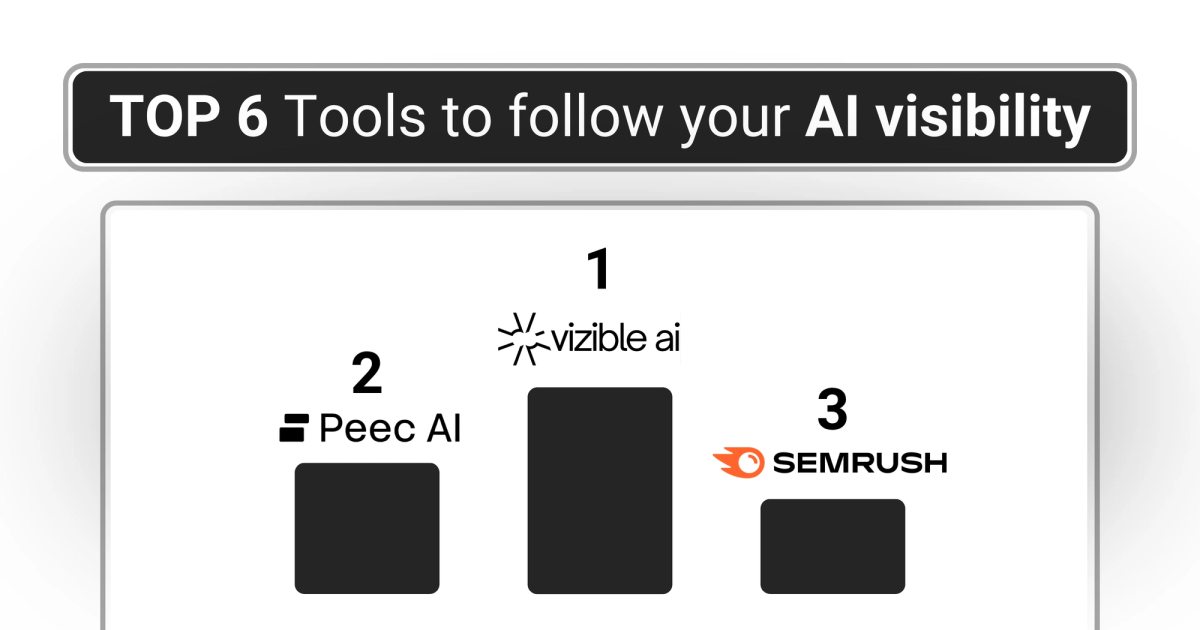
Vizible AI: best LLM coverage (6 engines), daily automated tracking, built-in sentiment and GEO recommendations. Ideal for B2B teams who want a complete tool without the complexity.
Peec AI: excellent for client reporting and agencies. Less focused on optimization.
Semrush AI Toolkit: relevant only if you're already a Semrush subscriber.
Ahrefs Brand Radar: powerful but reserved for large brands with significant budgets.
Profound: the Rolls Royce of the market, at a Rolls Royce price.
Otterly: simple and accessible to get started, but limited for serious ongoing tracking.
How to choose the right tool for your situation
The answer depends on three factors: your budget, your GEO maturity, and what you plan to do with the data.
You're just getting started
Start manually. Define 15 category prompts, test them in incognito on ChatGPT, Gemini, and Perplexity, and log the results in a spreadsheet. It's free, takes 30 minutes, and gives you your first measurement. Once you have your baseline, you'll know exactly what you need to automate.
You want to automate without overspending
This is the situation for most growth-stage B2B teams. You've validated the importance of the topic and you want daily automated tracking, competitor monitoring, and actionable data. Vizible AI was built precisely for this. It covers the 6 main LLMs, runs every day, and gives you concrete recommendations without needing a dedicated team.
You already have a SEO stack in place
If you're already on Semrush or Ahrefs and don't want to multiply tools, their AI modules can work as a starting point. Just keep in mind they were built for SEO first, with an AI layer added on top. They often lack depth on the signals specific to LLMs.
The metrics to prioritize
Whatever tool you choose, focus on these 4 fundamental metrics:
Mention rate
Out of 100 prompts relevant to your category, how many include you? This is your baseline metric. If this rate is below 20 to 30 percent, your priority is building presence, not optimizing it.
Average position
Being mentioned in third position on ChatGPT is very different from being first. Models tend to name the "default winner" first, and that's the one the user remembers. Track the evolution of your average position over time.
Dominant sentiment
LLMs don't just cite you, they describe you. The tone of that description shapes the reader's perception before they even visit your site. Neutral or mixed sentiment is as much of a warning signal as no mention at all.
Share of AI voice
Of all mentions in your category, what percentage goes to you? This is your market share in AI search. If a competitor captures 60 percent of mentions and you capture 10 percent, you have a fundamental problem, not just a technical one.
What tools can't do for you
A tracking tool tells you where you stand. It doesn't magically change your visibility.
LLM visibility is built upstream: by publishing content that answers your buyers' questions better than anyone else, by being mentioned consistently across independent sources (G2, Reddit, LinkedIn, press coverage), and by making sure your site is crawlable by AI bots like GPTBot and PerplexityBot.
The tool gives you the signal. The underlying work is still yours to do. But without the signal, you're working blind.
The right tracking tool doesn't replace a GEO strategy. It tells you where to focus your energy so it has the most impact.
Where to start today
If you've never measured your LLM visibility, here's the three-step plan:
Step 1: do the manual audit. List 15 prompts, test them in incognito on ChatGPT and Perplexity, log the results in a spreadsheet. You have your baseline in 30 minutes.
Step 2: identify the competitor appearing before you on the prompts where you don't show up. Analyze their presence (content, citations, reviews) to understand why LLMs prefer them.
Step 3: automate the tracking. Once your baseline is set, a tool like Vizible AI lets you monitor your progress daily across all LLMs, without spending hours on it every week.
The window is still open. Most of your competitors aren't tracking their AI visibility yet. The brands that start now are building a lead that will be very hard to close in 12 months.