A few years ago, share of voice was an advertising metric. You measured how often your brand appeared in media relative to your competitors. Straightforward, quantifiable, directly tied to budget.
In 2026, that logic has moved somewhere most marketing teams still aren't looking: the answers generated by AI engines. Every time someone asks ChatGPT, Gemini, or Perplexity to recommend a tool in your category, one brand gets cited. Maybe two. Rarely more than three.
AI share of voice is your percentage in that game. Understanding how it works, how to measure it, and how to grow it is probably one of the most underexploited competitive advantages available right now.
The simple definition
AI share of voice measures the proportion of your brand's mentions in LLM-generated responses, relative to the total brand mentions in your category.
In other words: if 10 ChatGPT responses mention tools in your category, and your brand appears in 3 of them, your AI share of voice on ChatGPT is 30%.
AI share of voice is to AI search what market share is to commerce: the number that actually tells you who's winning.
It's not an abstract metric. It's a direct translation of your authority in the minds of AI models. The higher it is, the more you become the default choice when someone searches for a solution like yours.
Why it's different from traditional share of voice
In classic SEO, share of voice is calculated on clicks and SERP impressions. You measure how many queries you capture relative to competitors. The logic is clear: the higher you rank, the more you capture.
In AI engines, it's fundamentally different for three reasons.
There's no results list
Google shows 10 links. ChatGPT generates a response with 2 or 3 names. You're in it or you don't exist. There's no position 7 generating a few clicks. The distribution is brutally binary.
Position within the response matters enormously
Being mentioned doesn't mean you're winning. If ChatGPT cites your competitor first and you third with "Vizible AI may also work in some cases," you're in the response but you're not the recommendation. AI share of voice incorporates both mention frequency AND position within the response.
It varies from one engine to another
You can have 40% share of voice on Perplexity and 5% on Gemini. These two engines don't share the same training data, don't crawl the same sources, and don't weight the same signals. A serious GEO strategy measures share of voice engine by engine.
How to calculate your AI share of voice, concretely
The manual method is straightforward. Here's how to do it in under an hour.
Step 1: define your prompt universe
List 15 to 25 questions your potential customers would ask an AI assistant to find a product like yours. Cover three types: broad category questions ("best tool for X"), specific use-case questions ("how do I do Y"), and comparison questions ("alternatives to [competitor]"). This is your measurement universe.
Step 2: collect the responses
For each prompt, open an incognito session on ChatGPT, Gemini, Perplexity, and Claude. Ask the question. Read the entire response. Note every brand mentioned, in what order, and with what tone.
The incognito session matters. LLMs sometimes adapt their responses based on conversation history. You want the "cold" answer, the one a stranger would see.
Step 3: calculate the ratio
The formula is direct:
AI Share of Voice = (number of your brand mentions) / (total brand mentions) × 100
For example: you test 20 prompts on ChatGPT. The responses contain a total of 48 brand mentions (yours and your competitors'). Your brand is cited 9 times. Your AI share of voice on ChatGPT is 9/48, or 18.75%.
Run the same calculation for each engine. You get a dashboard that reflects your commercial reality in AI, not a partial view from a single channel.
Step 4: weight by position
A mention in position 1 is worth more than a mention in position 3. For a weighted share of voice, you can apply a simple coefficient: 1.0 for the first mention, 0.6 for the second, 0.3 for the third and beyond. It's not an exact science, but it gives you a score far more representative of your actual weight in AI recommendations.
What your score actually tells you
A score below 10% means the models don't really know you. You haven't yet built a strong enough presence to appear as a natural answer in your category. The priority: entity recognition and independent citations.
Between 10 and 30%, you exist in the LLM world, but you're not the default choice yet. You're mentioned as an alternative, not the reference. The focus here is content depth and prompt alignment.
Above 30%, you're starting to be the name models cite first on a significant portion of queries. This is where the commercial lever becomes tangible: users who go through AI to find a tool in your category discover you first.
Above 50%, you own your category in LLMs. That's the position market leaders aim for. It doesn't happen in a few weeks, but it's built methodically.
The three factors that determine your share of voice
Understanding what makes this metric go up or down means understanding how LLMs work from the inside. Here are the three main levers.
Entity consistency
An LLM has a representation of your brand built from everything it has read about you. The more consistent and precise that representation is across sources, the more confidently the model associates you with your category. If you describe yourself 5 different ways across platforms, the model has a blurry picture of what you do. And a model with a blurry picture doesn't recommend you.
Volume and quality of independent citations
Every time an independent source mentions you the same way ("AI visibility tracking tool", "LLM monitoring", "GEO analytics"), it's a signal that reinforces the model's representation. It's not the raw number of mentions that counts, it's their consistency and their provenance. A mention in an SEO newsletter read by 15,000 people outweighs an anonymous forum post by a wide margin.
Alignment between your content and real prompts
If your articles answer the exact questions buyers ask AI engines, RAG engines like Perplexity will cite them directly. Every citation of your content in an AI response is both immediate visibility and a reinforcement signal for future training cycles.
AI share of voice vs SEO share of voice: what to track simultaneously
The two metrics are complementary, not competing. An article ranking number 1 on Google two years ago might today be cited by Perplexity in 40% of its responses on the same topic. Conversely, a brand absent from Google can have built a strong AI share of voice through its presence on Reddit, G2, and newsletters.
What the most advanced teams are doing today is tracking both in parallel. SEO to capture users who still search the traditional way. AI share of voice to capture those who've switched to AI assistants. And both audiences are growing at the same time.
A concrete example: how to read your own dashboard
Say you're a B2B analytics platform. You test 20 prompts across 4 AI engines. Here's what you see:
ChatGPT: 22% share of voice, usually in second position. Your main competitor is at 41%.
Perplexity: 35% share of voice, often in first position. Your blog posts are cited as sources in 8 responses out of 20.
Gemini: 8% share of voice. You barely appear. Your competitor is at 55%.
Claude: 18% share of voice, mostly in third position, with a neutral description.
This table tells you three precise things. Your content performs well on Perplexity because it's crawlable and well-structured. Gemini is a complete blind spot, suggesting an entity recognition problem on the sources Gemini favors (notably Google properties: YouTube, Google News, Knowledge Graph). And on ChatGPT, your competitor leads because they have more consistent independent citations, not because their product is better.
That's exactly the level of reading AI share of voice gives you. Not "I'm visible in AI", but "I'm strong here, absent there, and here is precisely what I need to fix first".
The most common mistakes in reading this metric
The same errors come up constantly when teams start measuring their AI share of voice.
Testing on only one engine. ChatGPT is the most familiar, so it's often the only one tested. But Perplexity has a different dynamic, Gemini is fed by a different ecosystem, and Claude may have a very different representation of your brand. A partial score can be very misleading.
Measuring once and concluding. AI share of voice is a living metric. It shifts every week with new publications, model updates, and competitor activity. A one-time measurement gives you a snapshot, not a trend.
Confusing mentions with recommendations. Being listed among 8 tools with "some users also use X" is not a recommendation. It's a low-level mention. The quality of the mention matters as much as its frequency.
Ignoring sentiment. A 35% share of voice with consistently neutral or mixed descriptions is less valuable than a 20% share of voice with positive, precise descriptions. How you're described is almost as important as whether you're cited.
How to increase it in practice
Growing your AI share of voice isn't about hacks or narrow technical optimization. It's about building authority over time. Here are the actions that actually move the score.
Unify and sharpen your description everywhere. Website, LinkedIn, G2, Capterra, Crunchbase: the same factual, precise wording about what you do. An LLM that has seen 30 consistent sources has far higher confidence than one that has seen 30 contradictory sources.
Write the reference content on the core topics of your category. Not just an article that mentions the topic. THE guide everyone cites. The content that answers the central question of your market better than anyone else.
Get mentioned in sources LLMs prioritize. Industry newsletters, comparison articles, Reddit discussions, detailed customer reviews. Every consistent mention in a credible source is one more vote for your share of voice.
Publish consistently for RAG engines. Perplexity and ChatGPT in browsing mode are looking for fresh content. An article published yesterday can appear in a response tomorrow. Publication cadence is a direct lever on share of voice for real-time retrieval engines.
Measure after every action. Publish a comprehensive guide? Rerun your prompts on Perplexity a week later. Get mentioned in a major newsletter? Check how your score moves over the following weeks. It's the only way to know what actually works for your brand in your category.
AI share of voice in 12 months
Search behavior is changing faster than most marketing teams anticipate. Gartner projects that 25% of traditional search volume will have migrated to AI assistants by end of 2026. For certain B2B categories, particularly SaaS tools, that number is probably already higher.
Brands measuring their AI share of voice today have a simple but decisive advantage: they know where they stand. They can act with precision. They're building a lead that latecomers will take months to close, because LLM visibility isn't won in a week, it's built week after week.
AI share of voice isn't a standard metric in marketing dashboards yet. But it will be. The brands measuring it now will have a head start on those waiting for it to become the norm.
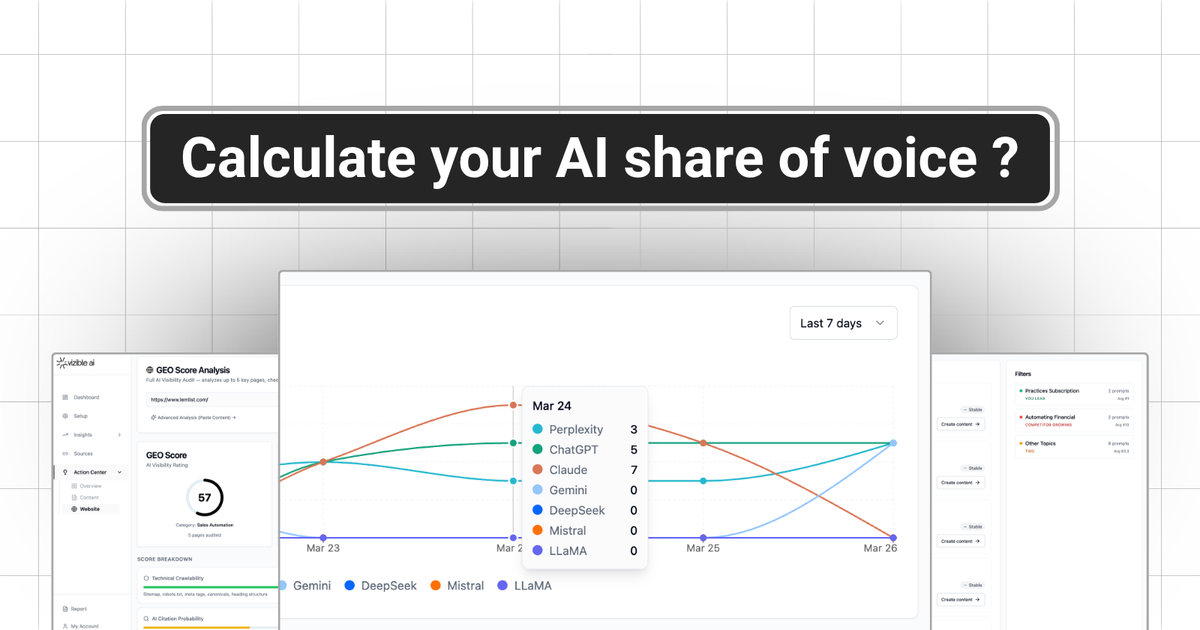
Vizible AI automatically calculates your AI share of voice across ChatGPT, Gemini, Claude, Perplexity, Mistral, and DeepSeek, every day, across your entire category prompt set. You know exactly where you stand, engine by engine, prompt by prompt, and you see the trend over time.